Raja Ampat: At the Heart of Wallace’s Paradise
 (Yi-Kai Tee/SeaTrek Sailing Adventures)
By Dr. Yi-Kai Tee
There are few places in the world that resist capture in words, places that transform even the most seasoned traveller or scientist into a reverent observer. For me, Raja Ampat—an archipelago off the northwest tip of New Guinea—was such a place. Though I have spent much of my career immersed in the complexities of coral reef ecosystems, I did not expect to be taken aback by the sheer majesty of these islands, where sea, stone, and sky seem to conspire in unison.
Sailing Raja Ampat with SeaTrek’s Ombak Putih

SeaTreks Expert Dr. Yi-Kai Tee on Ombak Putih. (SeaTrek Sailing Adventures)
Our voyage took us aboard the Ombak Putih, a vessel modelled after a traditional Indonesian pinisi sailboat, but with luxurious amenities and a world class crew. With her cobalt sails stretched against the wind, and her bone-white hull cutting gracefully across the currents, Ombak Putih, in all her 42 m long glory, felt less like transport and more like an emissary, carrying us into waters where history, biodiversity, and myth entwine.
Raja Ampat: The Beating Heart of the Coral Triangle
Raja Ampat is often touted as the epicenter of marine biodiversity—the beating heart of the Coral Triangle. For a marine biologist, it is akin to stepping into the original manuscript of life itself. Each reef seemed impossibly alive, a rolling tapestry of colour and motion. The water was so clear it felt less like peering through liquid and more like gazing through glass. From the deck of the Ombak Putih, the reefs opened up beneath us like a living portal, framed by vast limestone karsts that rose abruptly from the sea, their vertical faces dripping with dense jungle. These towering cathedrals were windows back in deep time, with several of them bearing petroglyphs from a time long since.
The significance of Raja Ampat extends far beyond its reefs. These islands occupy a central position in the biogeography of the Indo-Pacific, lying at the heart of what Alfred Russel Wallace, co-discoverer of natural selection, once called the Malay Archipelago. This is the crucible where Asian and Australasian lineages converge and entangle, where hornbills share the skies with cockatoos, and where the Birds of Paradise are at their evolutionary maxima.
Birds of Paradise in Raja Ampat’s Rainforests
One cloudy afternoon on Waigeo, we set off into the forest in search of one of the region’s most resplendent treasures: the Wilson’s bird of paradise. The journey itself was a pilgrimage. The air hung heavy with humidity, unyielding in its wetness, with the sun so weak as though penetrating the clouds above was a task so insurmountable. Yet the forest throbbed with a living cacophony as we approached.
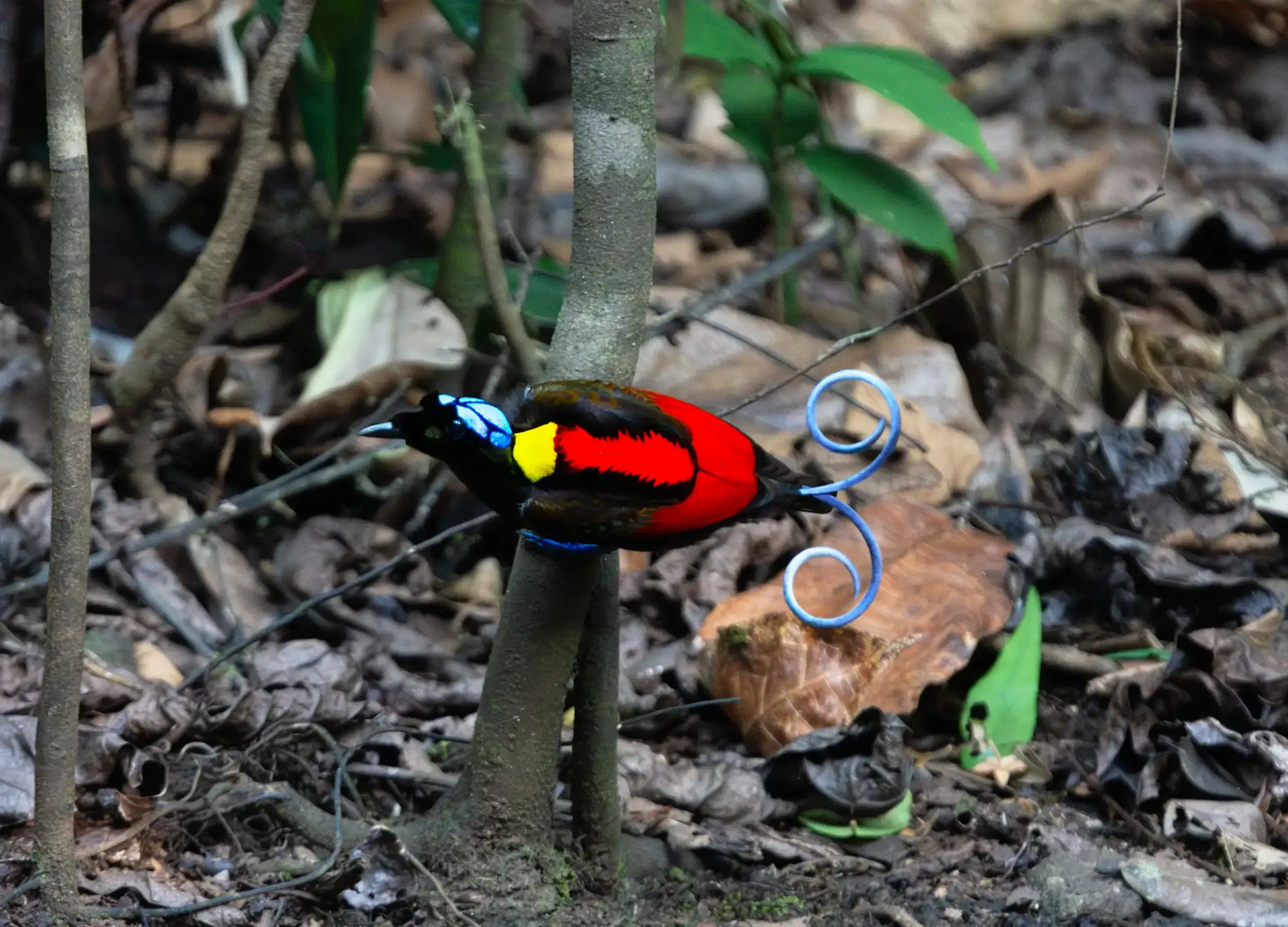
Wilsons Birds of Paradise in Waigeo forests, Raja Ampat. (Dr. Yi-Kai Tee/SeaTrek Sailing Adventures)
The male Wilson’s bird of paradise is a vision so improbable it borders on the surreal, like a whimsical drawing from a Dr Seuss book. The bird is a kaleidoscope of crimson, yellow, and iridescent blue, with bizarre curly lilac tail feathers. In the half-light, his electric colours glowed against the dim forest floor. He hopped and called, clearing away leaves in a ritual that has been repeated for millennia, an evolutionary performance honed to perfection. To witness this bird, so exquisite and so utterly unique, was to be reminded that evolution is not simply about survival—it is also about beauty, about extravagance, about the ineffable urge to be seen.
The Majestic Angelfish and Other Reef Encounters
Later, as we returned to the Ombak Putih and sailed once more among the islands, I found myself reflecting on the region’s legacy. The islands and reefs, as pristine as they are, were a reminder of the fragility of nature. The quiet pensiveness was a much-needed pinch in the face of absurd beauty, and as quickly as it entered my brain, vanished as I plunged into the next reef. Throughout my days spent here I expanded much of my energy and time chasing after one species— Pomacanthus navarchus, the Majestic Angelfish. In this case, the epithet requires little explanation—the fish lives up to its name.
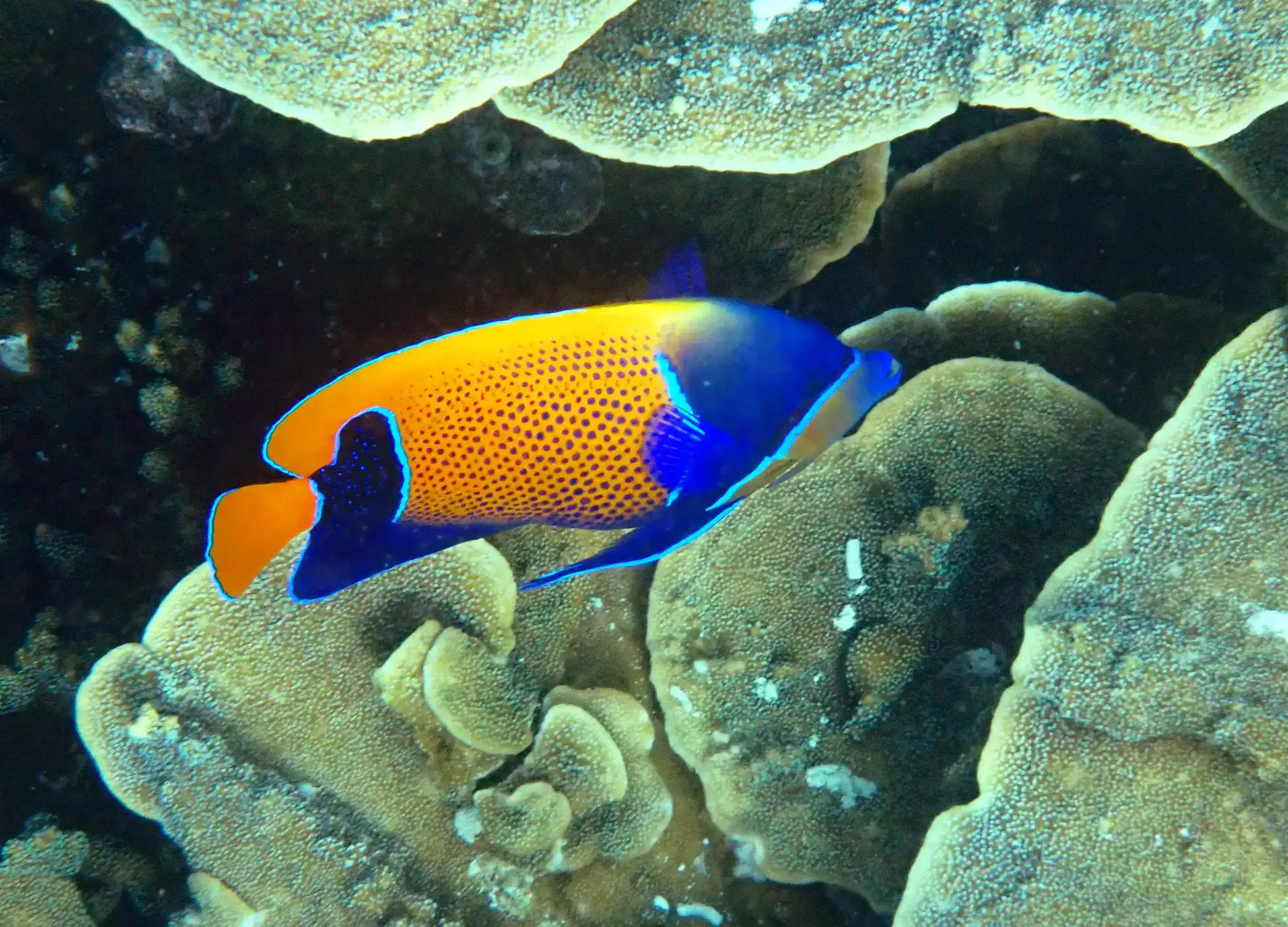
Majestic Angelfish in Raja Ampat. (Dr. Yi-Kai Tee/SeaTrek Sailing Adventures)
The Majestic Angelfish is not a rare species by any stretch, though its restricted distribution within the Coral Triangle makes this a species infrequently encountered by most. Its tangerine body, strapped on both ends by deep navy saddles makes this an unmistakable species. The species swam in abundance in Raja Ampat, and I encountered it on all the islands we visited. For a minute, time stops, and my fish scientist brain switches on. You see, much of my time underwater was devoted to this fish, and nothing else mattered much to me.
Why Raja Ampat is a Once-in-a-Lifetime Destination

Karst in Raja Ampat. (Dr. Yi-Kai Tee/SeaTrek Sailing Adventures)
What stayed with me most, however, is not any single encounter, but the totality of experience Raja Ampat is not a destination so much as a revelation. It is a place where one feels suspended between worlds: above the sea and below it, past and present, science and myth. As the Ombak Putih approached a sandy cay beneath a sky ablaze with stars, I reflected on how small I felt and how little we truly know. Raja Ampat truly is the lost world, and perhaps that is the greatest gift the islands bestow—not only their beauty, nor their biodiversity, but their invitation to wonder.

 (Agustina Siringoringo/SeaTrek Sailing Adventures)
 (Agustina Siringoringo/SeaTrek Sailing Advnetures)
 (Agustina Siringoringo/SeaTrek Sailing Adventures)
 (Antonin Borgeaud/SeaTrek Sailing Adventures)
 (Anastasia Louhenapessy/SeaTrek Sailing Adventures)
 (SeaTrek Sailing Adventures)
 (Dion Luas/SeaTrek Sailing Adventures)
 Joshua Edwards/SeaTrek Sailing Adventures