Buffalo Races in Sumbawa: A Run for Your Money
 Hizkia Hukom/SeaTrek Sailing Adventures
By Rachel Lovelock
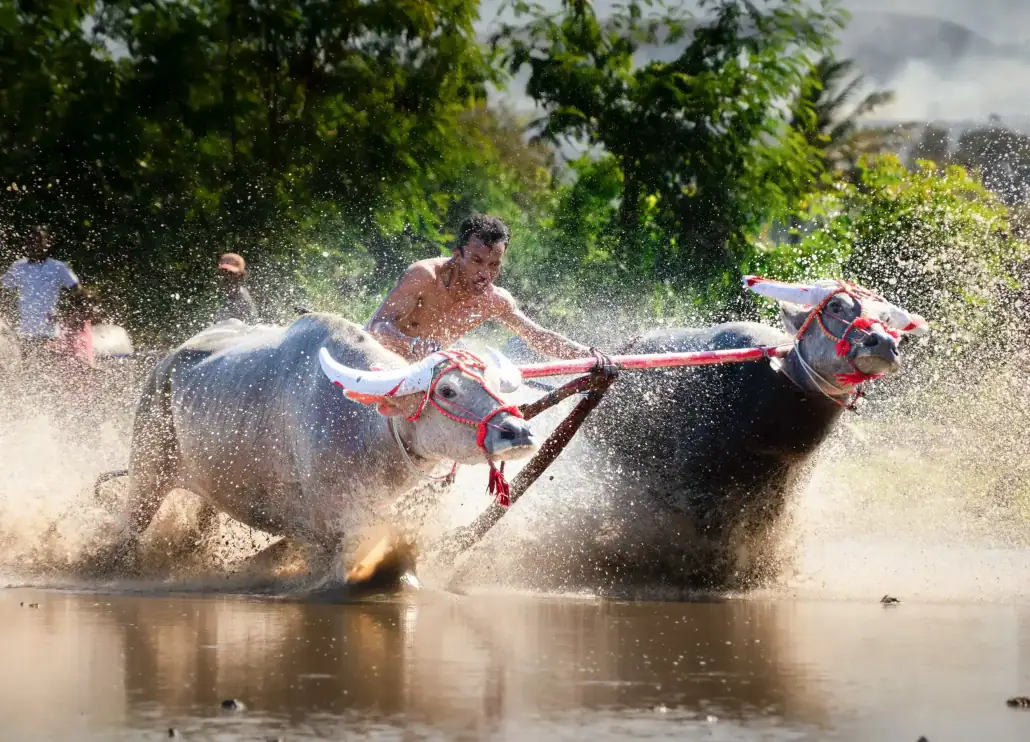
On a sunny Sunday in July, we would normally be taking the dog for a walk on the beach before enjoying coffee and croissants in our favourite café. This would be followed by a relaxing afternoon spent in the comfort of our home. Instead, I have just watched my husband balancing barefoot on a wooden plough, while “riding” a pair of water buffaloes at high speed from one end of a flooded rice field to the other.
Into the Mud
Except, he hasn’t made it to the end, instead he has been spectacularly catapulted off into the thick, slimy mud. His sole task, it seemed, was to simply hold on. Nevertheless, he picks himself up, unhurt, grinning and wet through, covered in mud, to raucous cheering, whooping and hollering from the spectators. Here, in this tiny rural village in Sumbawa, Indonesia, this is the first time a “bule” (a foreigner) has risen to the challenge.
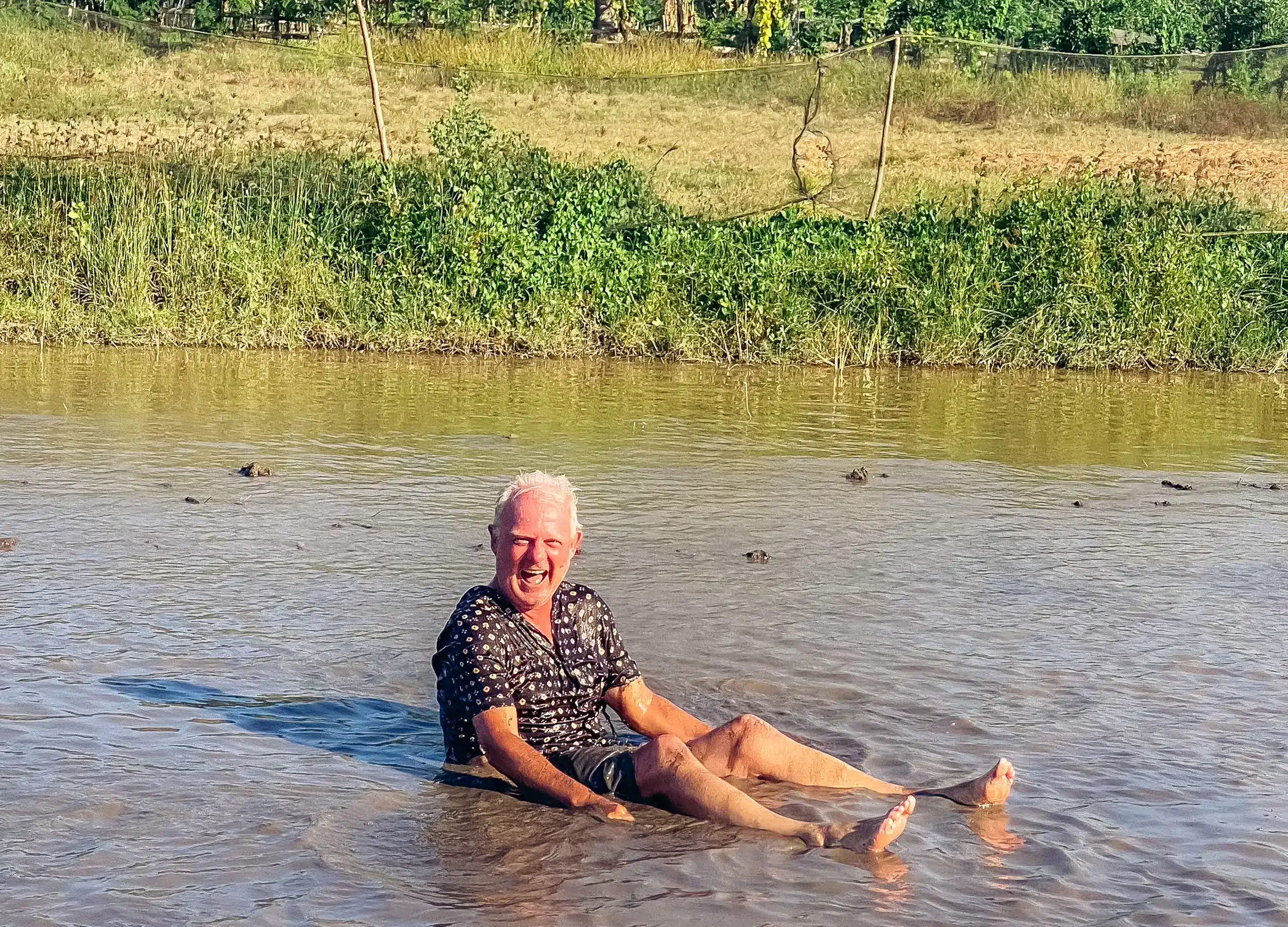
Fall into the mud. (Dion Luas/SeaTrek Sailing Adventures)
I’m a guest on The Katharina, cruising through the Komodo National Park and along the north coast of Sumbawa, while stopping off at some of the offshore islands as well as the vast Saleh Bay. Today, along with the other 11 guests on the boat, plus a few of the crew, we’ve come ashore and have been driven a short distance to a small inland farm, where we’ve been warmly welcomed by the local villagers.
Village Pride
It’s practice day for Sumbawa’s traditional water buffalo races, in which teams of farmers race through fallow-but-flooded rice fields with their prized bull buffaloes, which are normally used for ploughing. The buffaloes are paired, yoked together, and the rider or “jockey” stands on a length of wood attached to the yoke. At the far end of the 80-metre “racetrack” is a single wooden marker, and the aim is to direct the buffaloes past the finish line with the pole between them.
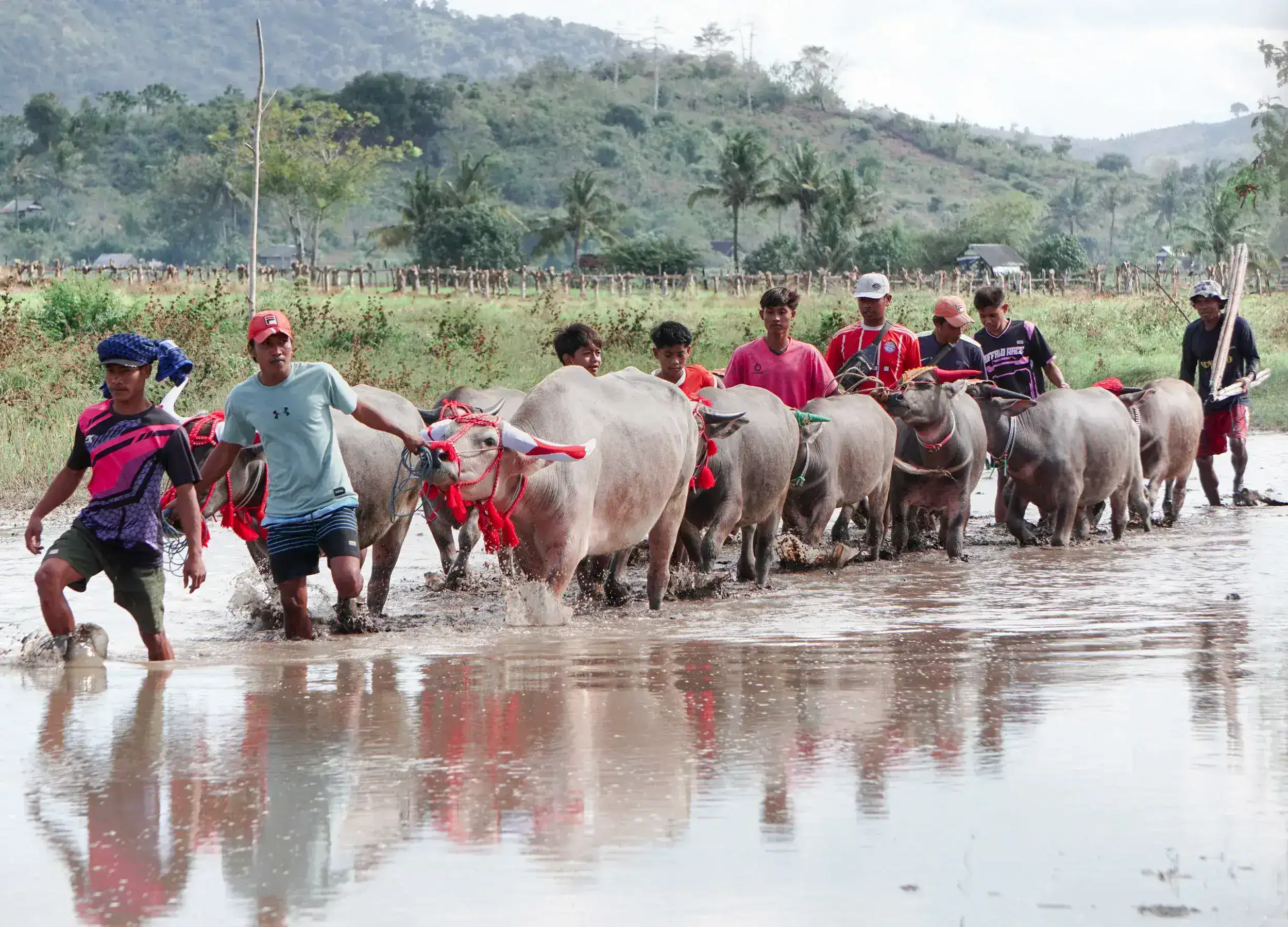
Leading the buffalo into the race field. (Agustina Siringoringo/SeaTrek Sailing Adventures)
Set against a backdrop of mountains, and held during the post-harvest season, the races culminate in a series of grand finals, to celebrate village anniversaries as well as Indonesia’s Independence Day on 17th August. The contests feature the region’s sleekest, most handsome water buffaloes. Festooned with strings of bells, silks and decorative harness, the bulls are cheered on by their villages, with the level of excitement and hilarity increasing to an even higher pitch every time an unfortunate jockey crashes to the ground.
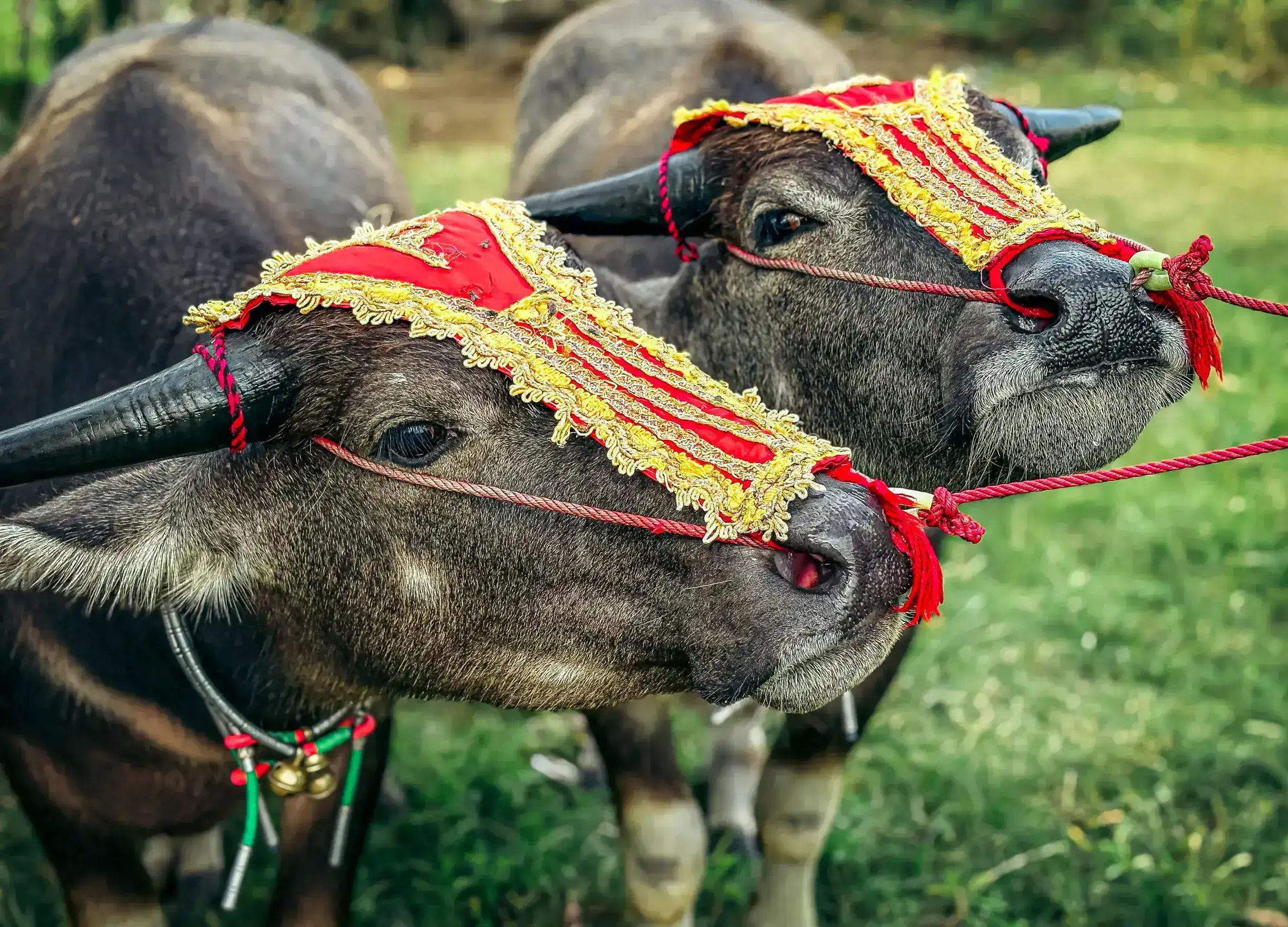
Handsome buffalo ready for the race. (Christine Conrad/SeaTrek Sailing Adventures)
This wet and wild ride in this remote pocket of Indonesia is more than just a competition. It’s a cultural ritual and a proud expression of community, strength, and skill. It’s raw, powerful, and deeply symbolic, telling of grit, ancestral heritage, and the unshakable bond between the people and their land.
Raising Champions
Although it is described as a race, the bulls do not directly compete against each other. They are judged by their performance, in particular, their speed and their ability to run straight. Every winning team gains a point for its village, with the most stylish contenders picking up bonus points for the splendour of their presentation. Similar traditional bull races take place in Central Sulawesi, West Sumatra, West Bali, Lombok, and on the island of Madura.
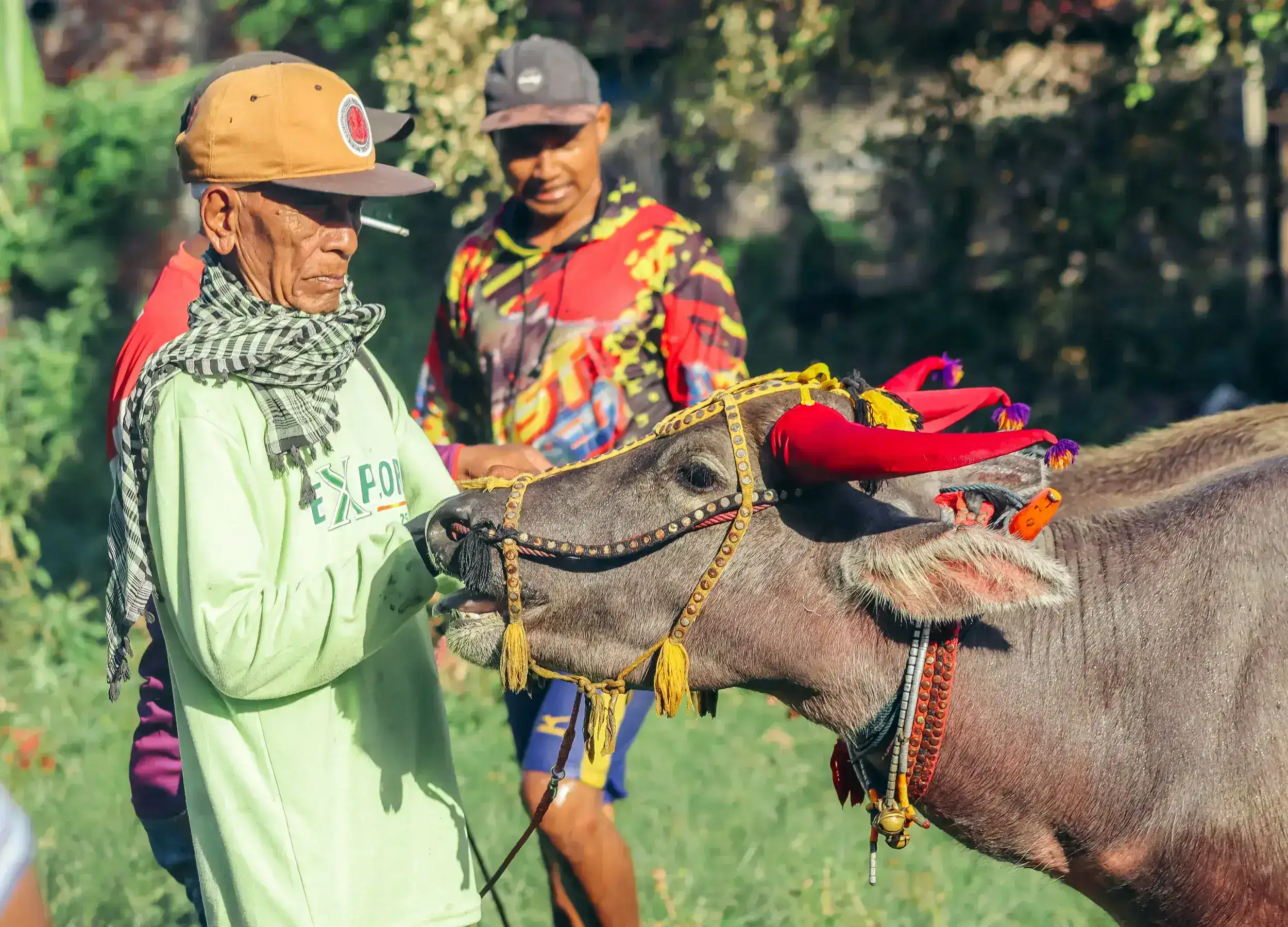
The buffalo treatment before the race. (Anastasia Louhenapessy/SeaTrek Sailing Adventures)
In the weeks leading up to the finals, the buffaloes are fed a high-energy diet comprising as many as fifty eggs per day. They are given herbal potions and a blend of traditional spices, including crushed ginger, pepper, chili, honey, and beer, believed to warm and strengthen the bulls. Every night, they are massaged and sung to sleep.
Touch Screen
Before the start of the contest, chili paste is applied to each animal’s anus to give it that extra push. The winning bulls then go to stud, based on the theory that fast bulls can also plough fast. In fact, we were introduced to the champion of the village, a magnificent beast whose name translates to “Touch Screen”; his value has recently shot up to the equivalent of a staggering US$10,000, a princely sum in a country where many live on a few dollars a day.
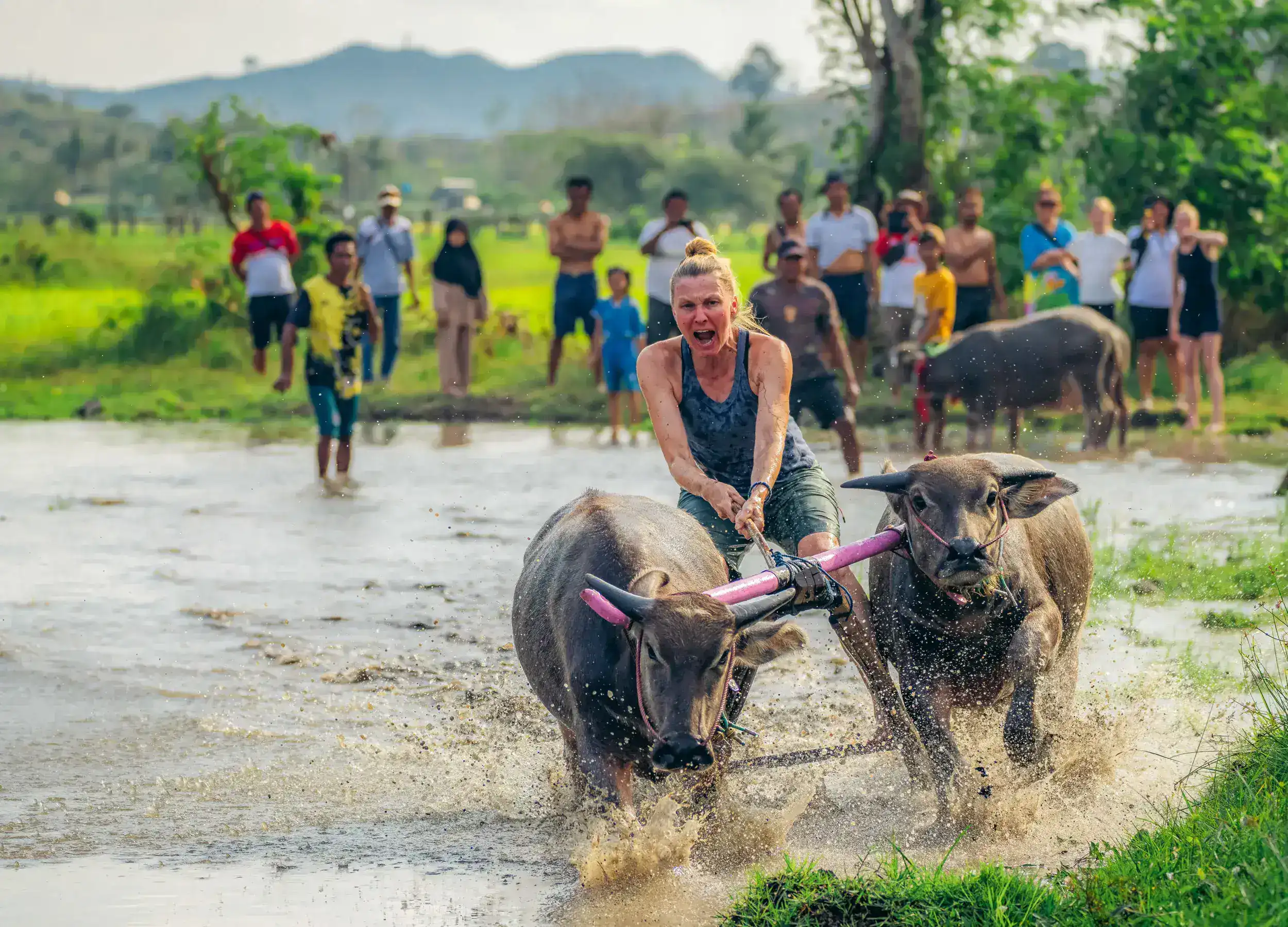
Guests join the buffalo race. (Brad Hays/SeaTrek Sailing Adventures)
At the month-end tournaments, a first prize for a winning jockey might be a brand-new spring mattress or a fridge, and a garland for each of his buffaloes. Of course, illegal betting will be rife.
As the practice races drew to a close, we walked over to an area where the buffaloes were resting after their exertion. We stroked their gentle faces and wished them luck.
 Dion Luas/SeaTrek Sailing Adventures
 (Dion Luas/SeaTrek Sailing Adventures)
 (Tim Jolly/SeaTrek Sailing Adventures)
 (Sally Sorongan/SeaTrek Sailing Adventures)
 (Agustina Siringoringo/SeaTrek Sailing Adventures)
 (Shannan Vines/SeaTrek Sailing Adventures)
 (Dion Luas/SeaTrek Sailing Adventures)
 (Brad Hays/SeaTrek Sailing Adventures)
 Dion Luas/SeaTrek Sailing Adventures
 (Agustina Siringoringo/SeaTrek Sailing Adventures)