Whale Sharks: Meet the Largest Fish in the World
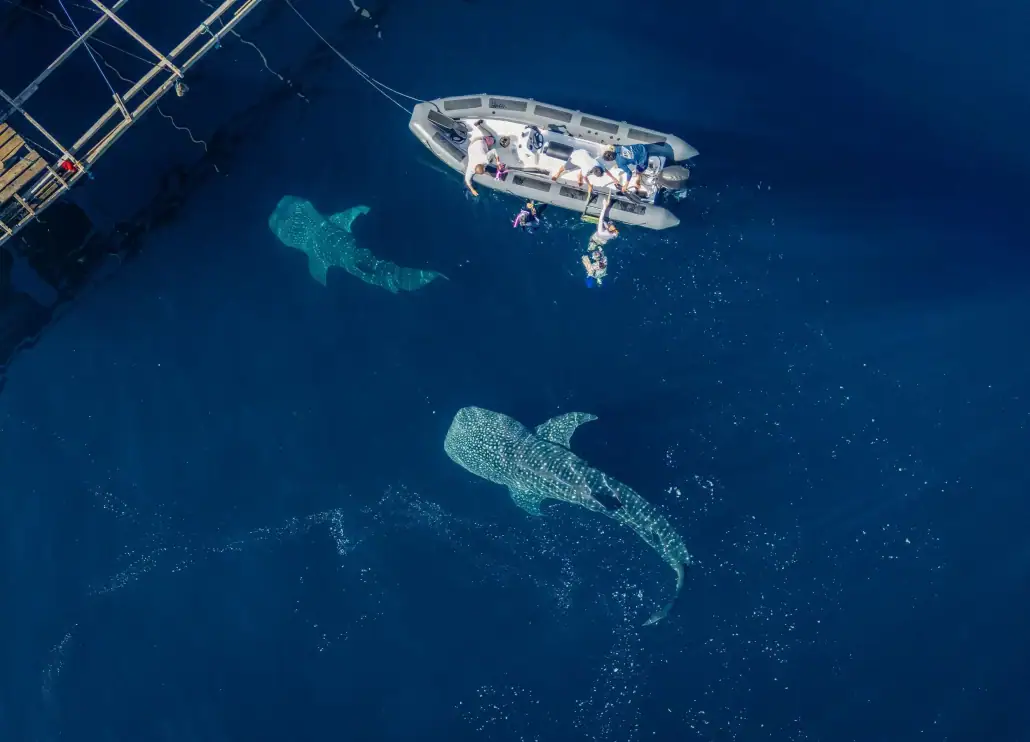 (Brad Hays/SeaTrek Sailing Adventures)
By Abd. Wahab
Whale sharks are among the many amazing underwater species we often encounter on our sailing trips in Indonesia. Known for their incredible size and unique skin pattern, swimming with these gentle giants firsthand is a once-in-a-lifetime experience. If you haven’t experienced it yet, then this is your sign to meet them.
But, before we meet these amazing animals in their natural habitat, let’s get to know them better because the more you know, the more you will care. This article will be a complete guide to whale sharks, covering their facts, morphology, behavior, size, habitat, conservation, and how to encounter them responsibly.
What is a Whale Shark?
Whale sharks are the largest living fish and the third-largest creature in the ocean, after the blue whale and the sperm whale. They can reach lengths between 12 and 18 meters and weigh up to 18,000 kilograms.
Despite their name, which includes the words “whale” and “shark,” whale sharks are not mammals like whales. Instead, they are fish, specifically sharks. They got the name “whale” because of their large size and feeding behavior, which are similar to some whales, but they are sharks, making them the largest shark species alive.

Gentle giants of the sea. (Brad Hays/SeaTrek Sailing Adventures)
Belonging to the shark family and reaching enormous sizes, whale sharks feed on some of the smallest marine creatures in the ocean. They feed through filter feeding, extracting zooplankton, fish eggs, coral eggs, and larvae by sucking in large volumes of water, which make up the majority of their diet.
Apart from their size, they are easy to identify. They have a broad, flat head, a large mouth, and a unique pattern of spots on their skin which look like stars against a night sky.
Whale Shark Facts at a Glance
These are whale shark facts you might need to know:
- Scientific Name: Rhincodon typus
- Size: 12-18 meters in length
- Habitat: Tropical and warm waters
- Behavior: Active during the day and solitary
- Diet: Plankton, phytoplankton, small fish, jellyfish
- Lifespan: 80-130 years
- IUCN Red List Status: Endangered
Whale Sharks Habitat and Distribution
Whale sharks’ habitat and distribution are largely influenced by water conditions and food availability. These gentle giants of the sea stay in tropical, warm waters, but are highly migratory animals. They can migrate long distances across the ocean, following water temperature, seasonal currents, and areas where plankton blooms as their main food source.
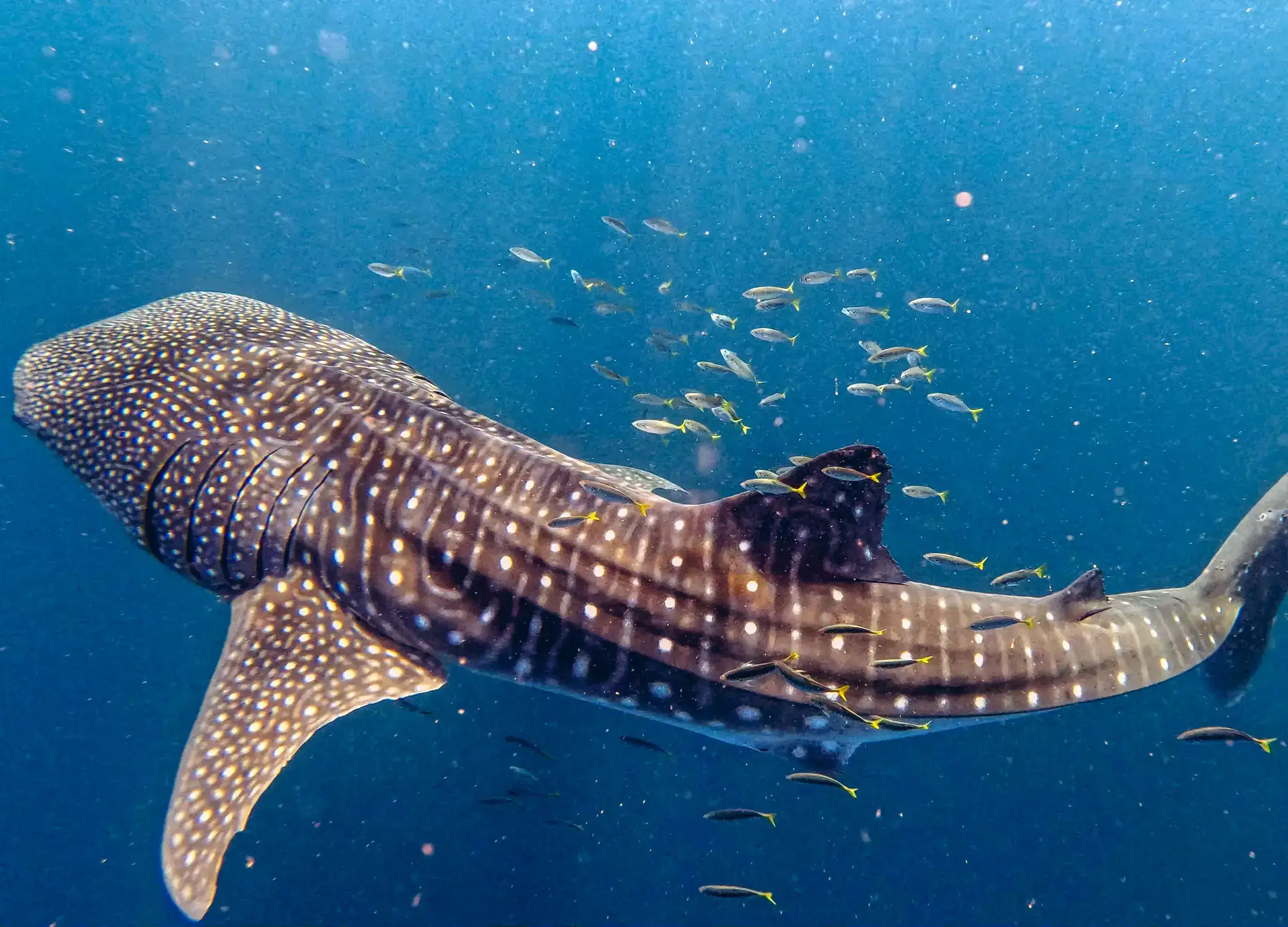
Surrounded by a school of small fish. (Agustina Siringoringo/SeaTrek Sailing Adventures)
These migration patterns make certain regions particularly attractive to this animal, including the waters around Indonesia. Located in the heart of the Coral Triangle, Indonesia is one of the best hotspots for whale shark habitats. The region’s high marine biodiversity and abundant plankton create an ideal combination of food and water conditions, attracting these gentle giants to migrate and stay in the area.
Although known as open-sea creatures capable of diving to depths of over 1,000 meters, they are most often seen near the surface or in coastal areas. During the peak season, usually between October and April, many travelers take the opportunity to see these magnificent creatures up close or even snorkel with them in their natural habitat. Read here to find the best places to swim with gentle giants in Indonesia.
Whale Sharks Size and Growth
Whale sharks’ size is typically about 12 meters in length, with the longest recorded individuals over 18 meters. Their incredible size makes them the largest fish and shark alive, and the third-largest marine creatures in the world after blue whales (33 meters) and Sperm Whales (24 meters).

Whale sharks’ size can reach up to 18 meters in length. (Brad Hays/SeaTrek Sailing Adventures)
The reason why whale sharks can grow that big is, possibly, because of their planktivorous feeding habits. Research shows a correlation between large body size and plankton-feeding animals. Their slow metabolic rate compared to other pelagic sharks also contributes to their ability to reach that massive size.
But not all of them grow that big. The largest individuals are mostly female due to differences in growth trajectories between male and female species. While males typically reach 8 to 9 meters, females can grow to 12 meters or more.
Diet and Feeding Behavior
Despite being the largest fish in the world, these giants feed on some of the smallest creatures in the ocean. Whale sharks’ diet consists of plankton, microscopic plants, and small fish near the sea surface.
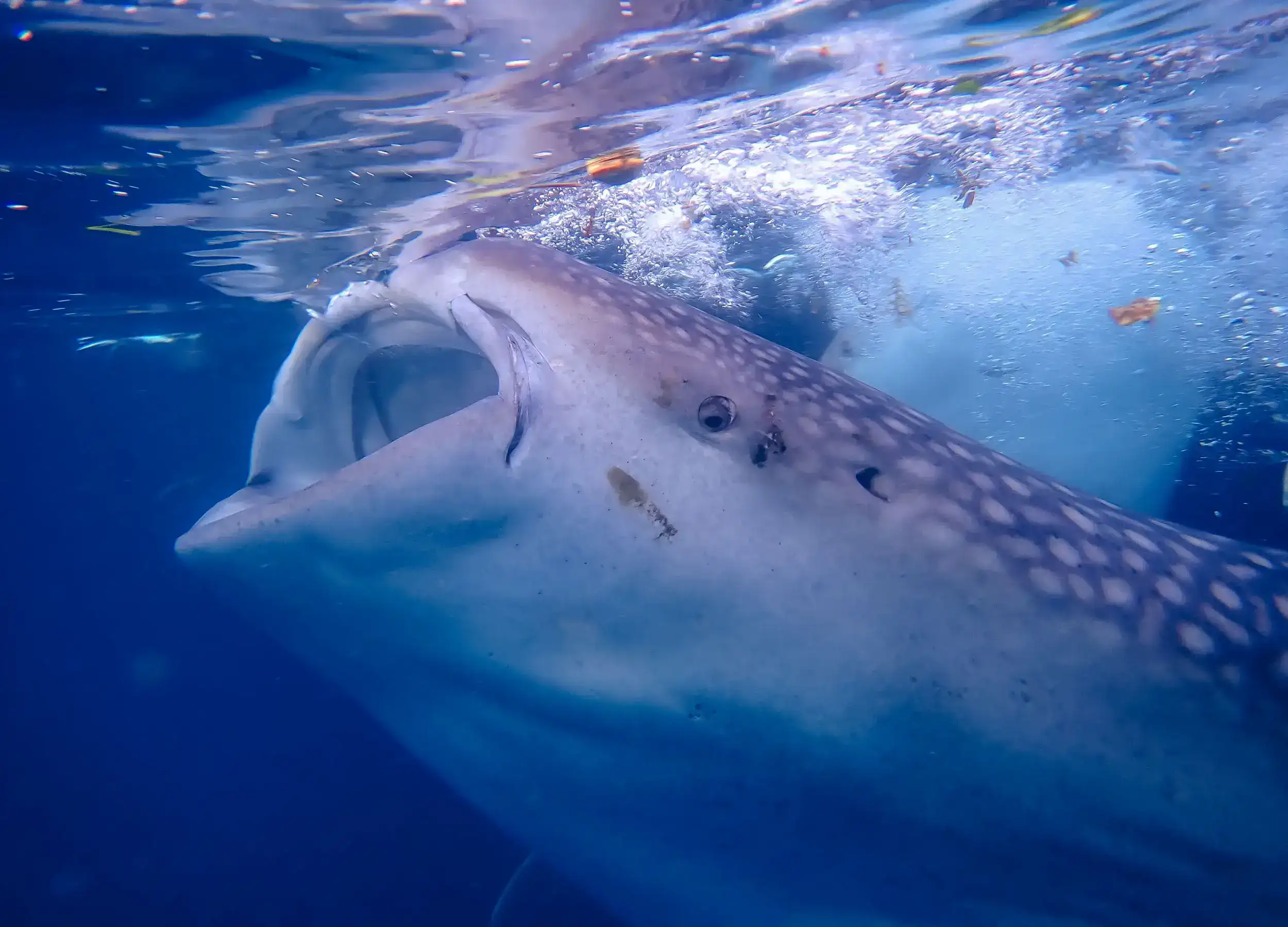
They have three feeding methods. (Dion Luas/SeaTrek Sailing Adventures)
Whale sharks are filter feeders, meaning they swim with their enormous mouths open, filtering food from the water. Unlike most sharks, they have around 3,000 tiny teeth, but these are not used for chewing or hunting. Instead, they relies on three feeding methods:
- Ram feeding: They swim at the surface with the dorsal surface of their head, dorsal fin, and upper lobe of the caudal fin usually exposed. With its body pitched upwards, the open mouth is held partially out of the water as the shark swims slowly (0.3–1.5 m/s), ramming water and food through its filtering apparatus.
- Suction feeding: They either remain horizontal or assume a nearly vertical position, stop or almost cease swimming, and actively suctions in plankton or small fish by repeatedly opening and closing their mouths. In the vertical position, the mouth is positioned just below the surface.
- Passive feeding: Swimming slowly (0.2–0.5 m/s) just below the surface, they filter food from the water with their mouth wide open.
Whale sharks are usually solitary feeders, but they often gather in large groups when food is abundant, such as during plankton blooms. These gatherings create spectacular natural feeding displays, where dozens of them can be seen feeding side by side in harmony.
Whale Sharks Conservation and Threats
According to the IUCN, the whale shark’s status is listed as endangered. Their global population is declining due to many threats, which is why Flora & Fauna included them among the ten species that need conservation attention in 2025.
Threats to Whale Sharks

The injured tail. (Dion Luas/SeaTrek Sailing Adventures)
Whale sharks face numerous threats, including bycatch fishing, targeted hunting, irresponsible tourism, ocean pollution, and an overheating ocean due to climate change.
- Bycatch: They can become entangled in fishing nets or accidentally struck by large vessels.
- Pollution: Plastic debris and microplastics enter the food chain and can be ingested by plankton-feeding animals.
- Climate Change: Rising ocean temperatures and shifts in plankton distribution can disrupt feeding grounds and migration routes.
- Irresponsible Tourism: Overcrowding or overfeeding can disturb their natural behavior and cause long-term stress.
Whale Shark Conservation Efforts in Indonesia
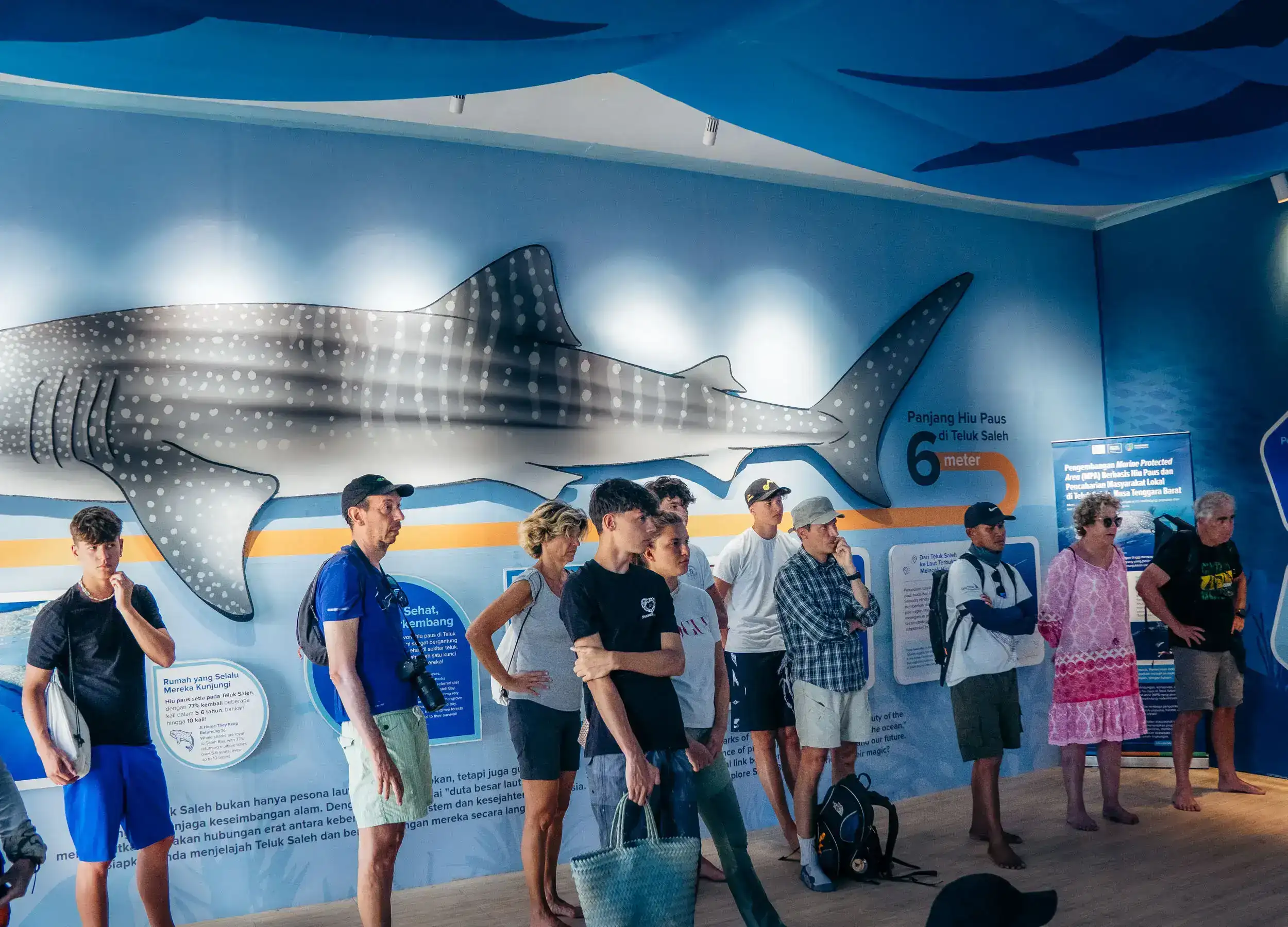
SeaTrek guests learning about whale sharks conservation at the learning center in Sumbawa. (Hizkia Hukom/SeaTrek Sailing Adventures)
In Indonesia, various initiatives have been implemented at both the local and national levels to support whale shark conservation.
- Community-based tourism: Fishermen and coastal communities are encouraged to protect this amazing animal through sustainable tourism, providing direct economic benefits from conservation.
- Tagging and tracking projects: Scientists tag to study their movements, identify critical habitats, and plan effective conservation strategies.
- Public awareness campaigns: Education programs, digital platforms, and responsible travel operators help spread knowledge about whale shark conservation.
How Can A Traveler Contribute to Whale Shark Conservation?

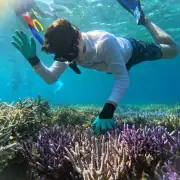
Snorkeling responsibly. (Agustina Siringoringo/SeaTrek Sailing Adventures)
As travelers, we believe that travel can be a tool for good. We can play an active role in protecting wildlife through responsible travel. We can contribute to whale shark conservation through small but meaningful actions:
- Choose responsible travel operators that support conservation initiatives.
- Contribute to citizen science by uploading your whale shark photos to global identification databases.
- Support local communities and NGOs working to protect these gentle giants and other marine habitats.
- Share your knowledge to raise awareness through social media or other platforms.
Relationship with Humans in Culture
Whale sharks have long shared the seas with coastal communities and many cultures, especially among Indonesian fishermen. Their presence is often considered a sign of good fortune: some believe that where this incredible creature appears, abundant fish will follow, guiding fishermen to the best fishing spots, while others see them as protectors of the sea.
Beyond cultural beliefs, this animal has become a symbol of both wonder and opportunity. Community-based whale shark tourism has allowed local populations, particularly on remote islands, to recognize the ecological and economic value of protecting these creatures.
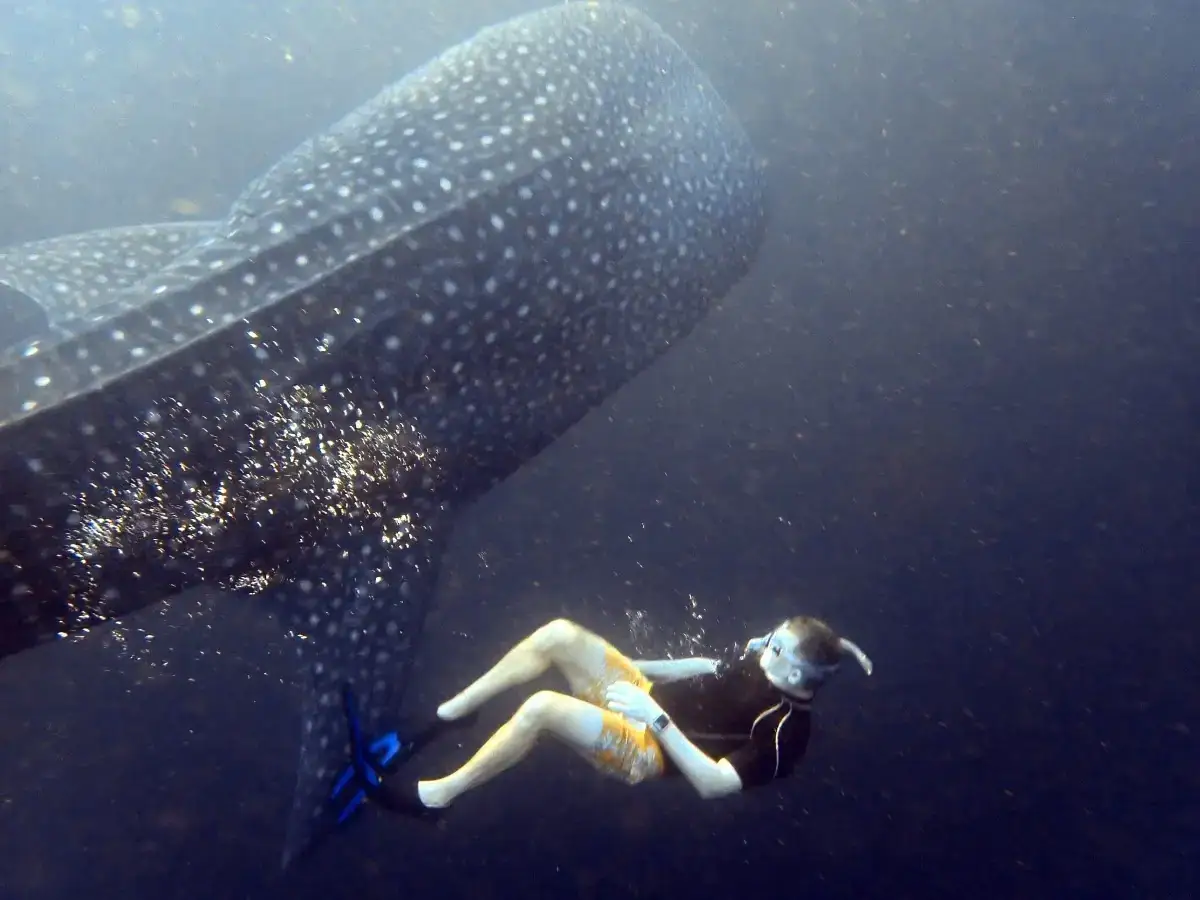
A magical encounter with a whale shark. (Anastasia Louhenapessy/SeaTrek Sailing Adventures)
For example, in Sumbawa, this giant gathering near fishing platforms known as bagan has transformed local livelihoods. Fishermen have shifted from traditional fishing to offering whale shark tourism experiences, creating sustainable opportunities that support conservation while providing income for the community.
The bagan fishermen’s relationship with the whale sharks is one of gentle coexistence rather than dependency. While the fishermen sometimes feed the sharks small amounts of leftover baitfish, this represents only a tiny fraction of the sharks’ daily dietary needs. The whale sharks continue to forage naturally in the surrounding waters, ensuring their health and independence while maintaining their long-standing connection with the fishermen.
Swimming with Whale Sharks in Indonesia
Swimming with whale sharks is one of the most memorable ways humans can connect with these gentle giants. Travelers who have experienced it often describe it as a once-in-a-lifetime adventure, and I totally agree. I’ve swum with them in two different locations in Indonesia, and each experience was unforgettable.
Top Whale Shark Spots in Indonesia
Indonesia has some of the best places in the world to swim with whale sharks in their natural habitat. Each of them offers a different experience:
- Kaimana Bay, West Papua: One of the most pristine and least crowded destinations, Kaimana combines rich marine biodiversity with incredible underwater visibility. As a bonus, you might also encounter a pod of dolphins swimming around.
- Saleh Bay, Sumbawa: Saleh Bay offers a perfect blend of marine and wildlife experiences. Most adventurers and nature lovers combine their trip here with a visit to Komodo National Park via cruise ship.
- Botubarani Bay, Gorontalo: In this place, you don’t need to go far away to meet them, because they can be very easily seen come near.
How to Swim with Whale Sharks Responsibly
While swimming with whale sharks is safe, it is important to respect these animals and their environment. Here is how to swim with them responsibly:
- Respect the environment: Remember that every marine site exists not only for us but also for future generations.
- Keep a safe distance: Maintain a distance of about 3 meters to protect both your safety and theirs. This allows for close observation without physical contact.
- Respect wildlife: Avoid large groups in the water; it’s best to swim in small groups to minimize disturbance.
- Choose responsible guides and operators: Plan your trip with knowledgeable local operators who prioritize both safety and conservation.
Frequently Asked Questions
Here are the most asked questions about this amazing animal:
Is a Whale Shark a Whale or a Shark?
A whale shark is a shark, not a whale. The “whale” in its name refers to its massive size, while “shark” reflects its classification as a fish in the shark family.
Why Is a Whale Shark Not a Whale?
Despite having “whale” in its name, a whale shark is not a mammal. Unlike whales, it has gills for breathing underwater and does not breathe air through lungs.
Are Whale Sharks Aggressive to Humans?
No, whale sharks are gentle giants and do not attack humans. They feed on tiny organisms like plankton and are often seen swimming calmly alongside snorkelers without showing any signs of aggression.
How Big Does This Gentle Giant Get?
Whale sharks can grow between 12 to 18 meters in length, making them the largest fish in the world and the third-largest marine creature after the blue whale and sperm whale.
How Long Can They Live?
Some research has estimated that whale sharks’ lifespan is around 30 to 150 years old, while they get mature by the age of 30.
What Makes Their Skin Unique?
Whale Sharks are called starry sharks because the dots on their skin look like stars, and it’s different for every individual, much like human fingerprints.
Is It Safe to Swim with Whale Sharks?
Yes, it’s very safe to swim with whale sharks. Whale sharks are calm and pose no natural threat to humans. However, it’s important to follow responsible guidelines to ensure both your safety and the well-being of the whale sharks.
Can They See in the Dark?
Yes. Whale sharks can see in the pitch black deep sea due to a mutation in their retinas. The mutation in the whale shark’s eyes activates the visual pigments that enable them to sense blue light, the only color that reaches the dark in the deep sea.
Ready to Meet the Gentle Giant in Their Natural Habitat?
Whale sharks are not just the largest fish in the sea. They are a symbol of a healthy marine environment and the balanced relationship between humans and nature. As travelers and ocean enthusiasts, our role goes beyond observing them. We have a responsibility to protect these gentle giants and their habitats, using travel as a force for good.
If you’re ready to see and swim with whale sharks closely, responsibly, and respectfully, join us on one of our upcoming trips and witness these giant creatures in their natural habitat.
 (SeaTrek Sailing Adventures)
 (Anastasia Louhenapessy/SeaTrek Sailing Adventures)
 (Agustina Siringoringo/SeaTrek Sailing Adventures)
 (Hizkia Hukom/SeaTrek Sailing Adventures)
 (Antonin Borgeaud/SeaTrek Sailing Adventures)
 (Dion Luas/SeaTrek Sailing Adventures)
 (SeaTrek Sailing Adventures)
 (Agustina Siringoringo/SeaTrek Sailing Adventures)
 (Antonin Borgeaud/SeaTrek Sailing Adventures)
 (Widya Hapsari/SeaTrek Sailing Adventures)