Cultural Ecology as a Way of Thinking
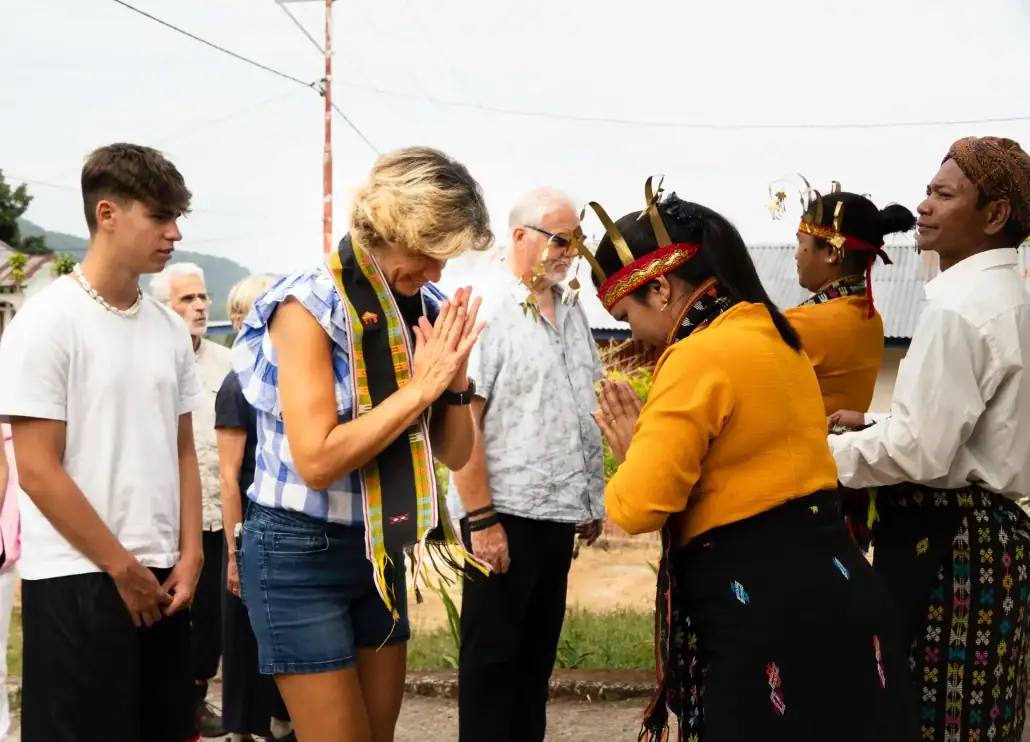 Hizkia Hukom/SeaTrek Sailing Adventures
By Prof Dr Anita Lundberg
An Eco-Cultural Anthropologist
As a cultural anthropologist living in and travelling to many remote areas of the Indonesian Archipelago, I have not simply studied local cultures but learned from them. My most enduring lesson has been a different way of understanding how humans are entwined with and in the world. Many traditional cultures are based on Animist spirituality, which involves humans in relation to the cosmos: animals, plants, elements, geology, climate, ancestors, spirits. Rather than being separate or outside the world, we are intricately involved in its webs of life. Thus, all our actions matter, including how we choose to travel and how that impacts local environments and cultures.
Ecology of Thinking
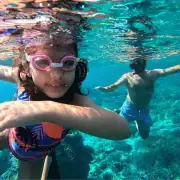
This way of seeing the natural, cultural, and spiritual world as intricately connected is like a cosmological or ecological system. It is best learned by seeing and feeling the connection between things around us. When you are out at sea on a pinisi under the stars, you can sense being part of the cosmos. When you go snorkeling and are suspended by the sea in a kaleidoscope of fish and corals, you may feel these connections.
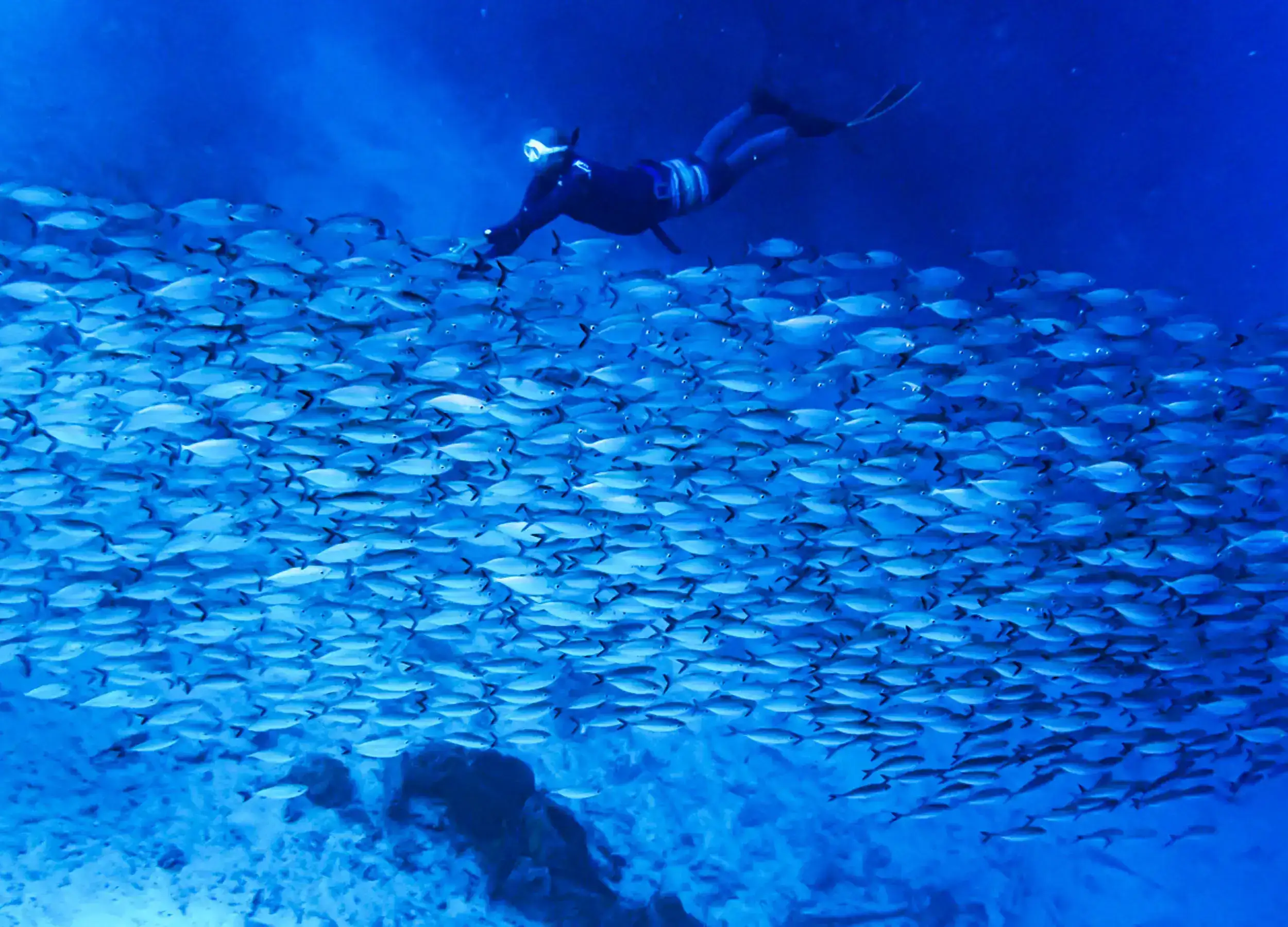
Snorkeling with a school of fish. (Peter Hungerford/SeaTrek Sailing Adventures)
“Ecology of Mind” is what the anthropologist Gregory Bateson (a husband of Margaret Mead) called this style of thinking. He was an interdisciplinary thinker, spanning anthropology (fieldwork in Bali and Papua), systems theory, cybernetics, linguistics, whale and dolphin communication, psychiatry, and ecology. I am likewise an anthropologist with an interdisciplinary background—liberal arts (BA), science and technology studies (MA), anthropology (PhD & PostDoc)—and draw on these diverse areas of knowledge to show the links between them as we voyage the archipelago. Following are just a couple of examples of how this ecology of thought may unfold during our trip from Komodo to Komodo.
Komodo Dragons & Mythology
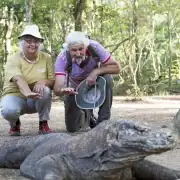
One of the highlights of a trip to Eastern Indonesia is visiting the Komodo dragons. These giant monitor lizards have been imagined through Western mythology as dragons, hence their name. History tells us how the Komodo dragons were ‘discovered’ in 1910, became famous through Western scientific writing, that their scientific name is Varanus komodoensis, they grow up to three meters, and they have been part of ongoing conservation efforts.
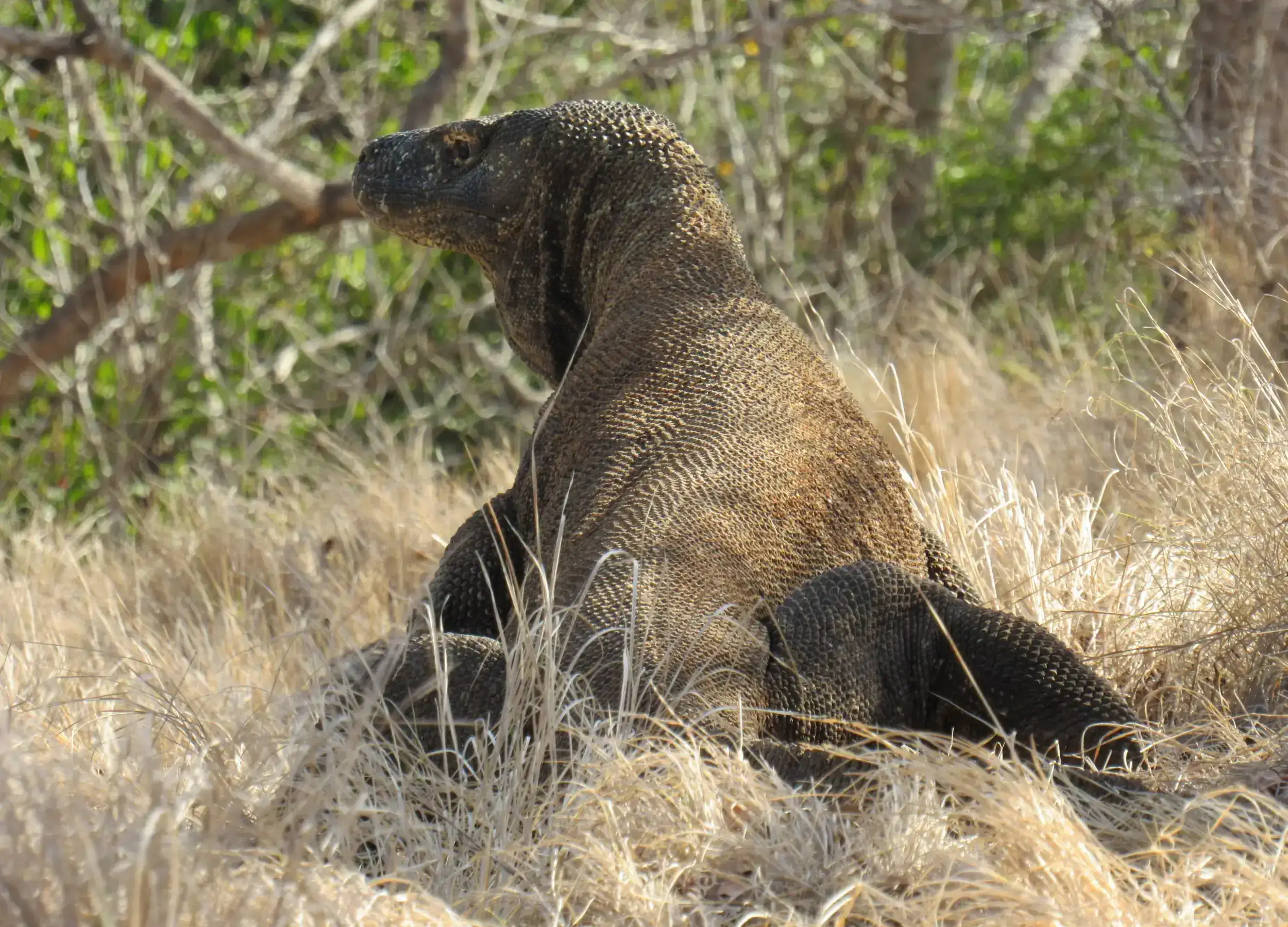
The iconic Komodo Dragon. (Tim Jolly/SeaTrek Sailing Adventures)
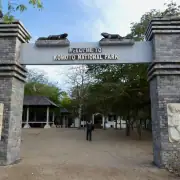
However, what this version of history neglects is that the Komodo dragon was very well known to the original people of Komodo Island (the Ata Modo). In fact, the Komodo dragon is part of local mythology in which the dragons and humans are related. According to legend, an early ancestor of the Komodo People gave birth to twins—a human boy, and a Komodo dragon girl. In this human-animal kinship, Komodo and humans are relatives, dragons are part of community and cannot be hunted. Thus, this myth is the very beginning of conservation. In the local language, dragons are commonly called “modo”, but when people communicate with emotional intent, they call them “sabae” (twin). Today the Komodo People are guides on the Komodo National Park islands, they continue practices of conservation, and actively resist over-development of the island.
Whale Sharks & Bagan Fishermen
Another human-animal relation is between whale sharks and bagan fishermen. Bagan platforms are floating wooden structures used for night lift-net fishing, attracting small fish, shrimp, and squid with strong lamps. They are seen across Indonesia and in some areas the fishermen, who may live on the platforms for months at a time, have formed relationships with whale sharks (Rhincodon typus). Such is the case in Triton Bay in West Papua and Saleh Bay in Sumbawa where SeaTrek ventures.
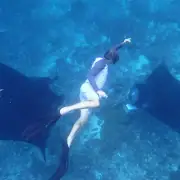
Whale sharks are giant fish (not a whale at all), growing up to 18 meters and living over a hundred years. They are the gentle giants of the tropical seas. Despite their enormous mouths, they are filter feeders and survive on plankton, small shrimp, and fish such as sardines and anchovies. As the bagan fishermen draw up their nets from the night’s catch, they offer leftovers to the whale sharks, which are believed to be harbingers of good fortune. SeaTrek has established a relationship with the bagans, and thus you, as an onboard traveller, are part of this relation of conservation in which protecting these giants brings long-term benefits to the fisher community. This is very important because a whale shark fin is worth an enormous amount of money.
Whale sharks are recognizable by their complex pattern of white spots and lines set against dark, often bluish-grey, skin. The unique arrangement of spots on an individual shark’s body (especially behind the gills) is as distinctive as a human fingerprint. Using photo-identification (similar to programs used to map star constellations), scientists can track individual whale sharks and learn about their migration. Still, so much is unknown, and the early life of the whale sharks remains an enigma. However, recently a lead emerged from Saleh Bay. A neonatal baby shark was spotted by bagan fishermen. This indicates that the bay may serve as a birthing and nursery area for whale shark pups. The calm waters of the bay have high plankton levels while nutrients from mangroves, seagrass, coral reefs, and bagan fishermen, make the bay a stable food area for pups.

Gentle giants of the sea. (Brad Hays/SeaTrek Sailing Adventures)
The beautiful patterns on the whale shark’s bodies and the way in which they appear to glow when the giants swim through bioluminescent plankton have also served as inspiration for a famous science fiction film—but you will need to come on board to hear the talk more about these science and science fiction connections.
Pinisi & Boat Building
Sailing on board a pinisi likewise offers inspiration by thinking through the boat itself. SeaTrek’s ships, Katharina and Ombak Putih are modern pinisi, yet their boat building follows in the wake of a long history of maritime culture in Indonesia. Boat design in the archipelago has been traced back to the 8th century, and on some isolated islands you can still find older styles of boats or witness pinisi being built on a beach. Many of the ancient cultural practices are still recognisable, including giving thanks to the spirit of the trees that are felled to provide the wood, and blood sacrifice as part of the ritual to launch a new boat to sea.
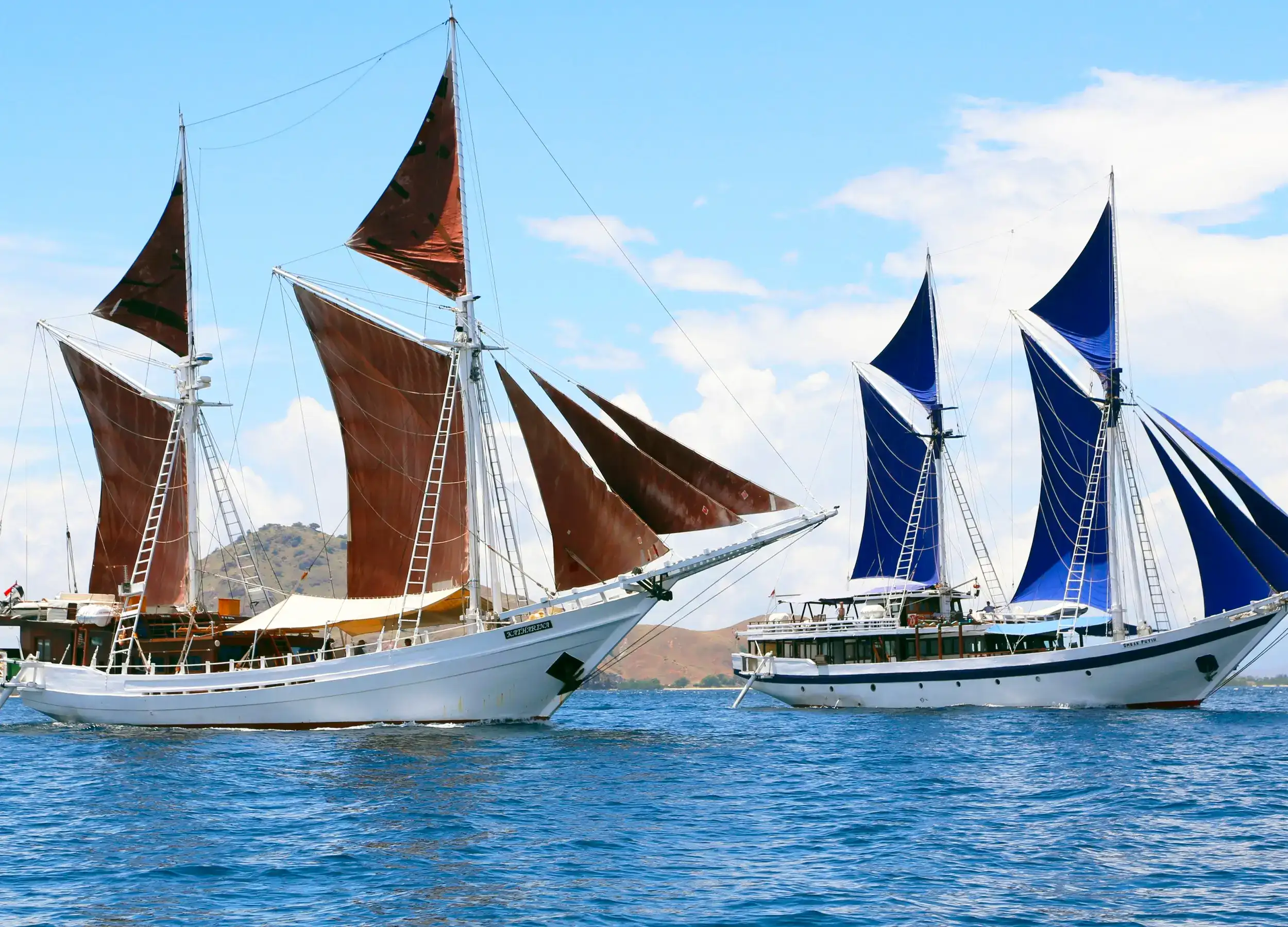
SeaTrek both boats Katharina and Ombak Putih. (SeaTrek Sailing Adventures)
Historically, the pinisi was a trading boat, reaching the farthermost islands of the archipelago. The boats were built in southern Sulawesi, and the local Bugis people were known as formidable seafarers. Their towering pinisi with billowing black sails were a sight to behold. They sailed the spice route in Indonesia, but some were also pirates. It is thought that the term boogie man comes from the word Bugis, such was the fearsome imaginary of their ships.
Tambora Volcano & Climate Change
On the Komodo to Komodo trip, we will pass the Tambora volcano. Luckily, we are not in a pinisi sailing past back in 1815, for in that year the volcano caused the most powerful eruption in recorded history. Ash spewed high into the stratosphere to be carried slowly around the world, blocking the sun’s rays and causing a volcanic winter known as the Year Without a Summer. Climate change saw extreme weather and harvest failures with significant effects in the northern hemisphere, including America, England, and Europe. Crop failures in turn led to famines, migrations, and outbreaks of disease.
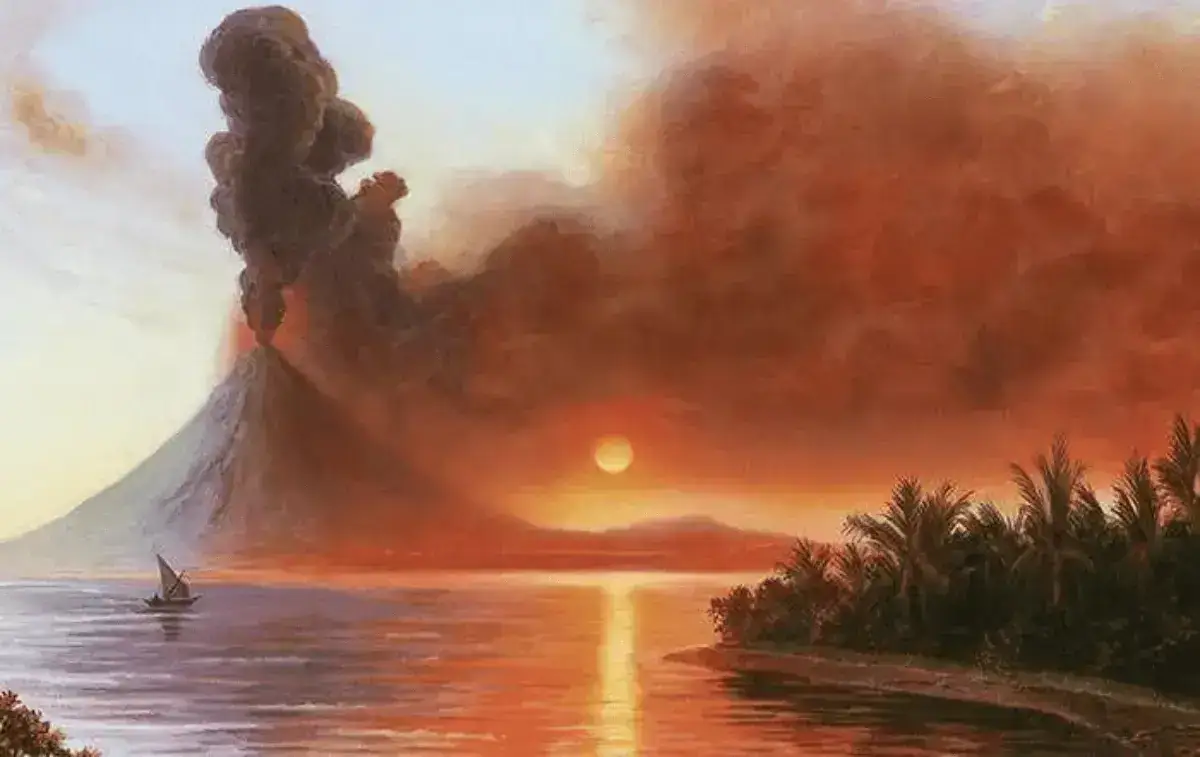
A depiction of the Mount Tambora eruption. (Google)
Yet the weather anomaly is also connected to the arts. In England J.M.W. Turner was painting apocalyptic landscapes that have since been labelled “volcanic sunsets”. The change in his use of red colour pigments have sparked discussions of art as a visual measure of history. In Europe, Mary Shelley, Percy Bysshe Shelly, Lord Byron and John William Polidori, among other friends were holidaying near Lake Geneva in Switzerland. Incessant rainfall forced them to stay inside their villa. There, inspired by old German ghost stories, Byron suggested a competition to write the scariest tale. Mary Shelley came up with Frankenstein, while Byron scribed a ‘A Fragment’, Polidori used this tale as his inspiration for The Vampyre, which in turn became the basis of Bram Stoker’s Dracula. These works are central to the genre of Gothic horror.
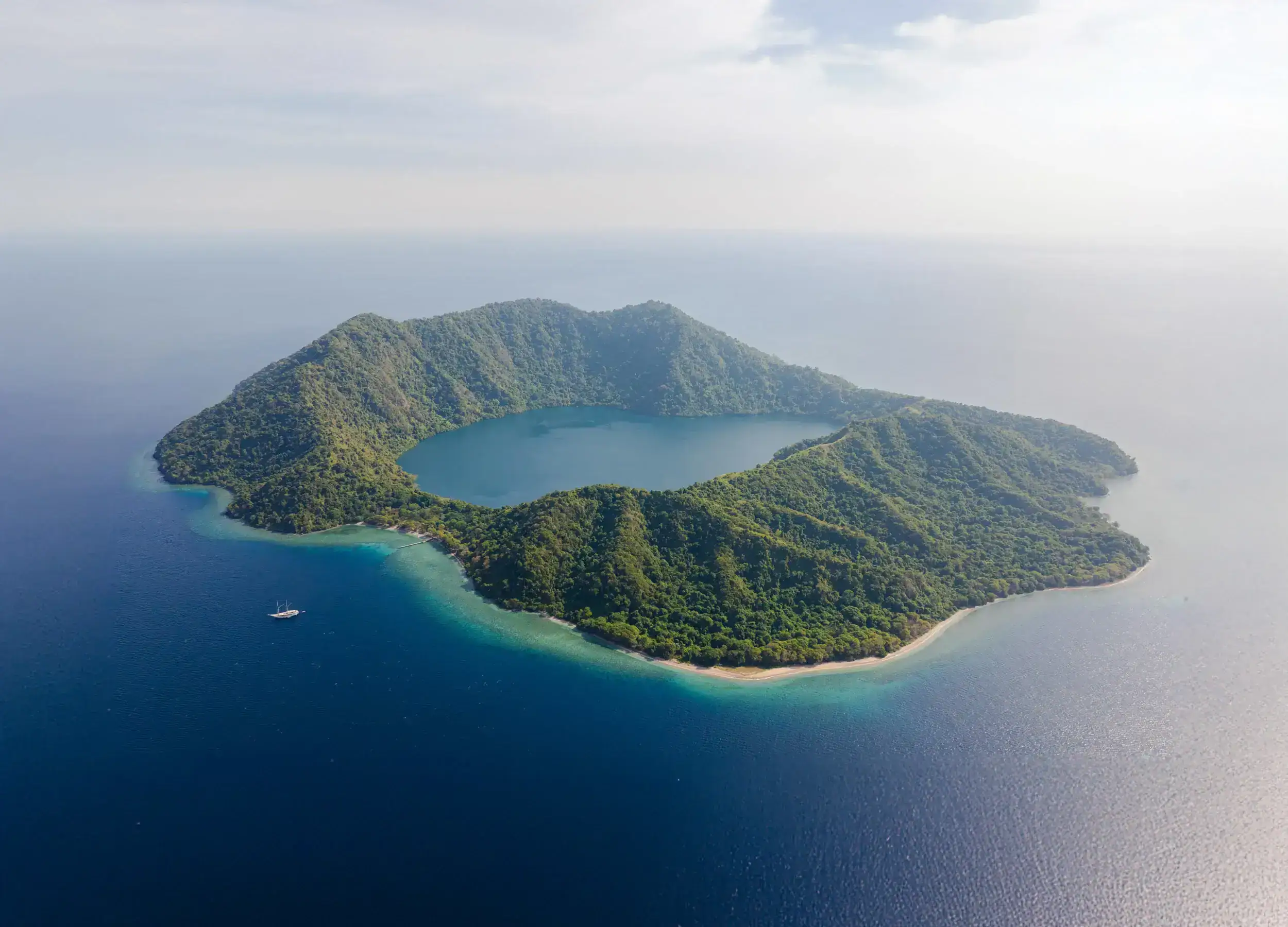
Satonda Island. (Joshua Edwards/SeaTrek Sailing Adventures)
This was all far away and in the future. Meanwhile, back in Sumbawa and its neighbouring islands, the effects of the volcanic eruption were immediately horrifying. Pyroclastic lava flows reached the sea on all sides of the peninsula, causing deaths of humans, animals, and plants, and ongoing famine. Entire villages were buried under pumice. Tsunamis with estimated heights over 10 metres caused devastation. Such volcanic and tsunami activity is ancient to the “Ring of Fire”. On nearby Satonda Island, itself an extinct volcano, we will experience swimming in a rare saltwater crater lake. The saltwater is thought to be caused by a tsunami over 4,000 years ago, and its evolutionary effects include the formation of special corals.
Sailing the Archipelago
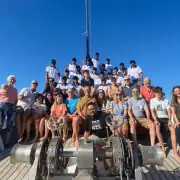
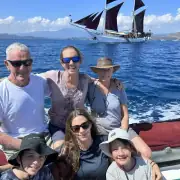
Each SeaTrek cruise is unique to the crew and guests on board the pinisi. We form our own little ecosystem affected by everything around us—the boat, the sights we sail past, marine and terrestrial life we encounter, weather, stars. Also, the islands we encounter and the people, cultures, and belief systems of each island group. While some cultural theorists have called this an ecology of thought, others have called it archipelago thinking, because island groups offer so much diversity yet are all connected by ocean currents. As we sail these seas, we can dream of how different islands (of thought) can be connected.
 (Dion Luas/SeaTrek Sailing Adventures)
 (SeaTrek Sailing Adventures)
 (Dion Luas/SeaTrek Sailing Adventures)
 (Agustina Siringoringo/SeaTrek Sailing Adventures)
 (Jason Lye/SeaTrek Sailing Adventures)
 (Nita CJ/SeaTrek Sailing Adventures)
 (SeaTrek Sailing Adventures)
 (Anastasia Louhenapessy/SeaTrek Sailing Adventures)
 Dion Luas/SeaTrek Sailing Adventures